Paris · Painting
A Trace of Love Revealed by X-Ray: Courbet's The Wounded Man
Musée d'Orsay · Paris, France
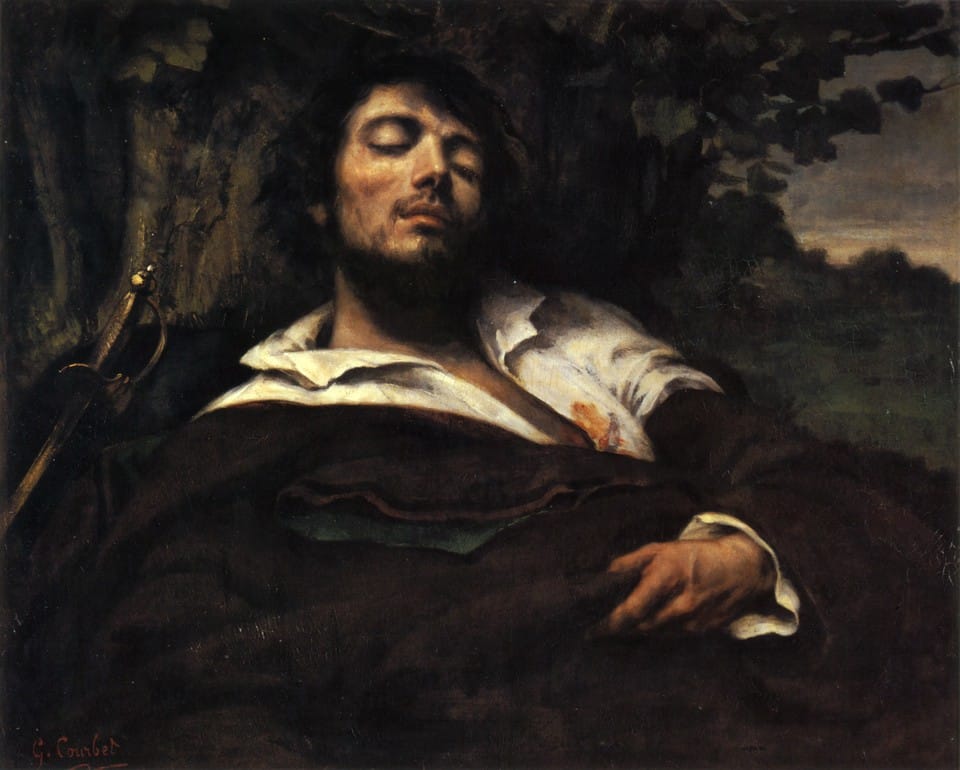
Blood on his cheek, a bloodstained shirt, a sword lying beside him — the scene looks for all the world like the aftermath of a duel, except that the expression on his face is strangely calm. This is a self-portrait Courbet painted of himself.
So why did he depict himself as wounded? An X-ray of the canvas revealed the answer: there was once a woman painted beside him. She was Virginie, a woman Courbet had been in a relationship with for ten years, with whom he'd had a child. Whatever exactly happened between them remains their own private story, but Virginie eventually left Courbet, taking their child with her, and the breakup left him devastated. The painting had originally shown the two of them together, content — but after she left, he painted over it, transforming the scene into the wounded figure the title now describes.
This explains the decade-long span of dates noted on the placard beside the painting: Courbet had painted the original version and then reworked it ten years later. Throughout his career, Courbet painted self-portraits whenever his mental state shifted significantly, using them to capture not just his outward appearance but his inner life at that moment.
The painting also shows the clear influence of Rembrandt, the so-called "master of light," through its dramatic use of chiaroscuro — sharp contrast between light and shadow. The background recedes into darkness while the figure himself seems caught in a spotlight, which only sharpens the sense of pain radiating from the canvas.