Paris · Painting
Henri Rousseau – Child with a Doll
Musée de l'Orangerie · Paris, France
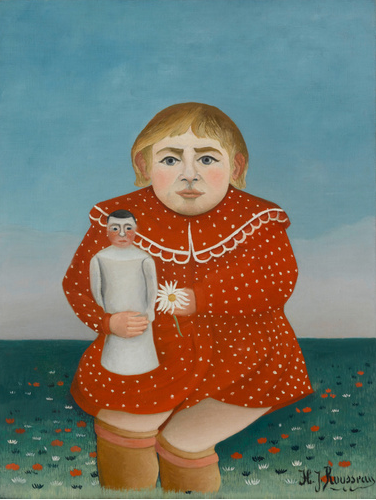
Despite the title, the face here looks unusually mature for a child. The figure reads as a girl, yet a closer look reveals what seems like faint, dark stubble along the jaw, and there's no neck at all. The legs are drawn oversized, while the right hand holding the doll is tiny, almost infant-like; the upper body faces forward while the lower body twists slightly, giving the whole figure an ancient Egyptian quality. By academic standards, this is hardly a technically accomplished painting.
So why was it so well received? The answer lies in the moment it was made. France was industrializing rapidly, and new artistic styles kept appearing one after another, leaving many people exhausted by the pace of change — in art as in everything else. Against that backdrop, Rousseau went the opposite direction entirely, reaching back to a style from before art had "progressed" at all. He lacked formal training, true, but skills like perspective and shading were there for the learning if he'd wanted them; instead, he made "the primitive" itself his subject and deliberately set those conventions aside. And the gamble paid off.
For that shift in thinking, critics later likened him to Paolo Uccello — the medieval painter credited with opening a new chapter in art through his discovery of perspective — dubbing Rousseau "the Paolo Uccello of our age."