Paris · City Walks
Centre Pompidou
Le Marais · Paris, France
Keep walking past the Fleux stores and you'll reach the last stop on our Marais tour: the Centre Pompidou. Strictly speaking, it isn't in the Marais at all, but it sits right on the district's edge and links France's past with its present. If the Marais we've seen so far greets us with a devotion to tradition and preservation, the Pompidou is the source of living French culture today: a mecca of contemporary art that boldly expresses Paris's modern vision, and a monumental building that shows the city's cultural ambitions at a glance.
President Georges Pompidou wanted to reaffirm France's place as the world's art capital, a position it held through the 19th century, and to revive those glory days. So he decided to build a multidisciplinary cultural center on Place Beaubourg in the 4th arrondissement, in the historic heart of Paris. Beaubourg means "beautiful village," and Parisians often use it as a nickname for the Pompidou, so "Let's meet at Beaubourg" means "Let's meet at the Pompidou."
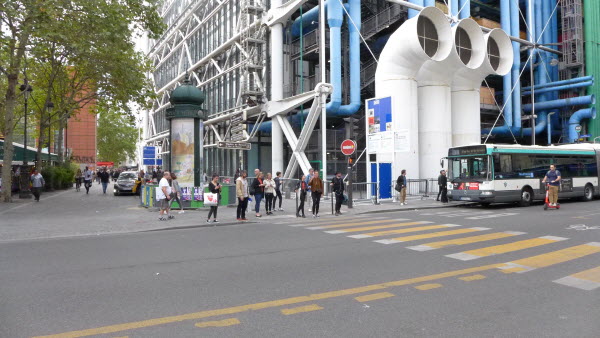
Do you see that huge block of white, red, blue and yellow pipes and structure, all on the outside, looking as if it's still under construction? That's it. Opened in January 1977, it looks so modern you'd never guess it dates back decades. Its heavily technological exterior drew criticism at the time for not suiting Paris, and locals protested that a giant oil refinery was going up in the middle of the historic city. Yet, contrary to those fears, it has become a world-class museum of modern art and a multipurpose cultural center that draws Parisians and visitors from around the world.
The key to understanding this seemingly complicated building is emptiness. To create flexible interior space that could hold art of any shape or size, the designers put all the structural and functional systems on the outside. Everything pushed outdoors is color-coded in the industrial manner: white for the structure, red for the transport systems, green for plumbing, yellow for electricity, and blue and white for heating, cooling and ventilation. From the Marais side, you're looking at the back of the building, where the library entrance is.
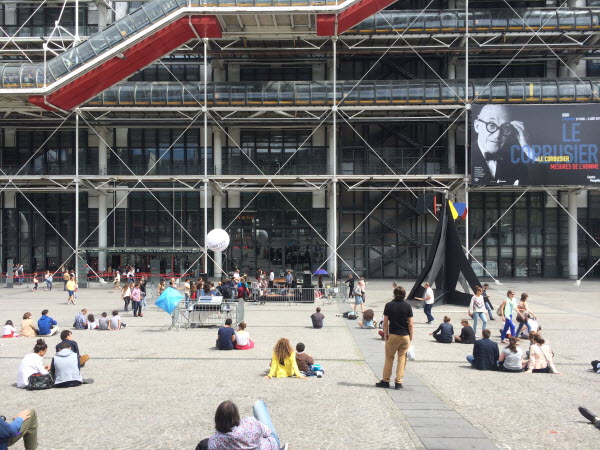
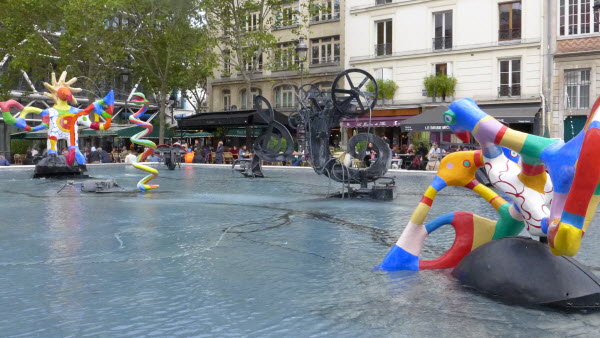
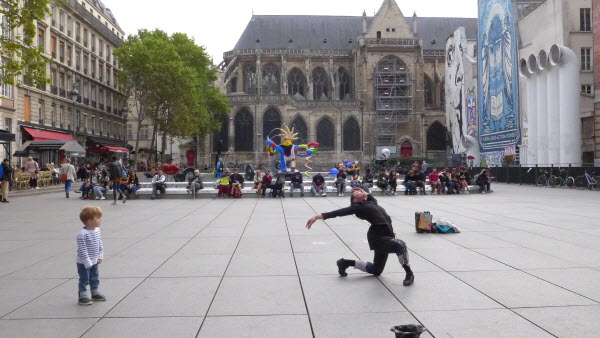
Walk a bit farther, past the Stravinsky Fountain on your left, to see the front. Notice the wide open plaza. It's a place for Parisians to relax in the city, but also an extension of the center, where street art that doesn't fit inside is displayed and performances and live art unfold with the building as a backdrop. Its energy and openness quickly put to rest the worries raised at the time about a clash between tradition and modernity.
Emptiness inside, emptiness out front. In 1971, Paris held an international design competition for the center, and the winners were two then-unknown architects in their thirties: Italy's Renzo Piano and Britain's Richard Rogers. The main reasons their design was chosen were that they boldly left more than half the site empty as a public plaza, and that by emptying the interior, they offered possibility and change rather than a conventional, fixed structure.
The complex houses the National Museum of Modern Art, a public information library, an industrial design center, an institute for music and acoustic research, the Ministry of Culture, a cinema, performance halls and a bookshop. As its name, "Centre" and not "Museum," suggests, it's far more than a place for sculpture and painting. You can see work from the early 20th century to the 21st: photography, film, architecture, new media, installation art, graphic design, crafts, furniture and industrial design.