Paris · Sculpture
A Name That Got It Wrong: The Borghese Gladiator
Borghese Gladiator · Paris, France
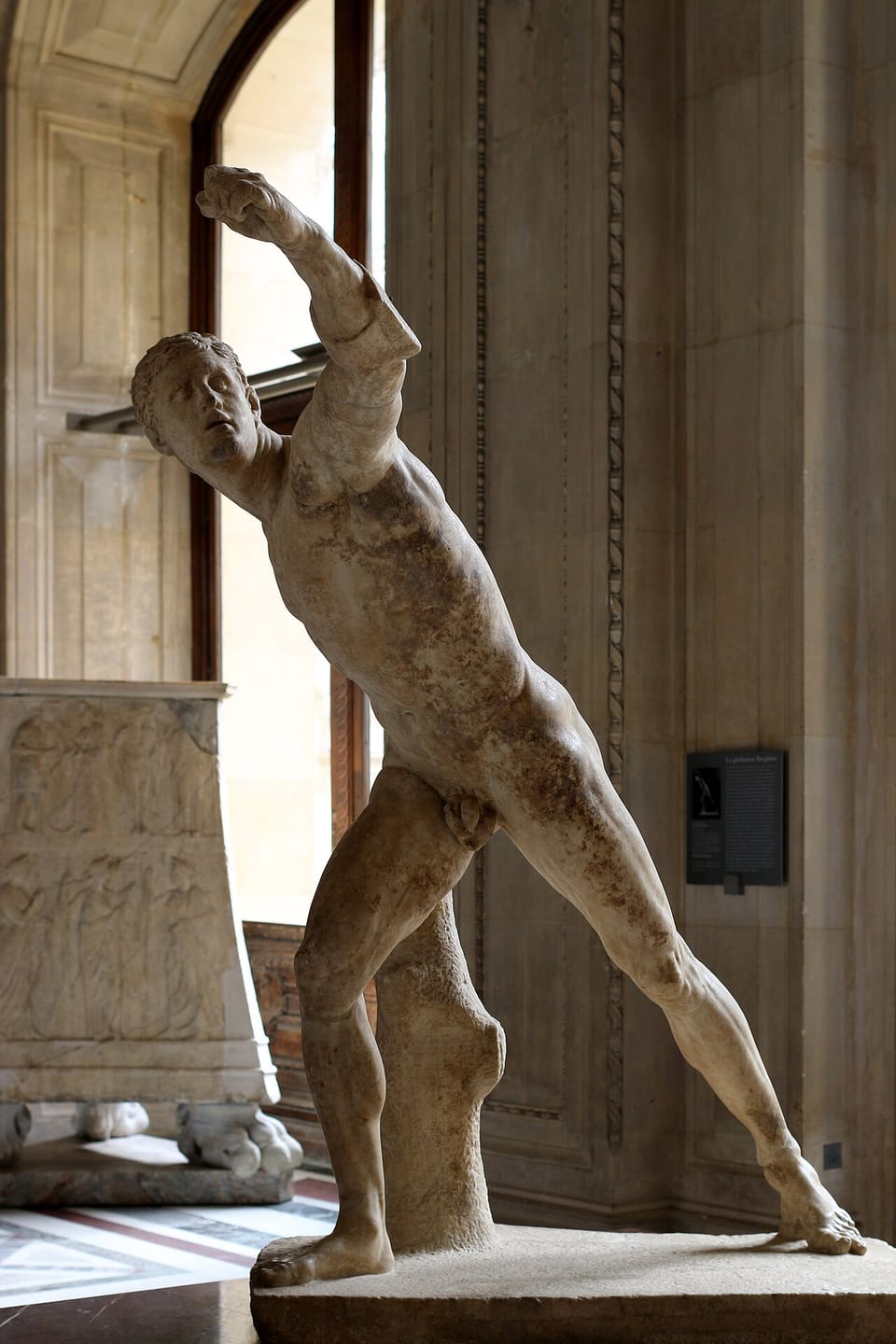
The Borghese Gladiator ranks among the greatest surviving works of ancient Greek sculpture, celebrated for its dynamic pose and finely rendered, muscular physique — a masterpiece that has inspired generations of artists since.
Its shield and sword are long gone, making the pose harder to read today, but the figure was originally shown parrying a mounted swordsman's blow with a shield, poised to counterattack. The right arm, which once held that missing sword, was damaged and later restored — look closely and you can spot a subtle difference in color between it and the original torso.
The sculpture was unearthed in 1609 at Anzio, once the site of Emperor Nero's villa. At first it was thought to be a Roman work, and because the pose resembled a gladiator locked in combat in the arena, it was given that name. Only later did scholars determine it was actually an ancient Greek sculpture — a staggering 2,100 years old. The name stuck even after the misidentification was corrected.
At the base is a tree-trunk-shaped support carved in marble, added to help stabilize the heavy stone figure. An inscription on it reads: "Made by Agasias, son of Dositheos, citizen of Ephesus" — preserving the sculptor's name for posterity. Ephesus, located in modern-day Turkey, was a Greek colony at the time. The statue eventually made its way to Rome after the Romans conquered the region, was later found at Nero's villa, passed into the Borghese family's collection, and finally arrived at the Louvre thanks to Napoleon.