Portrait of Père Tanguy
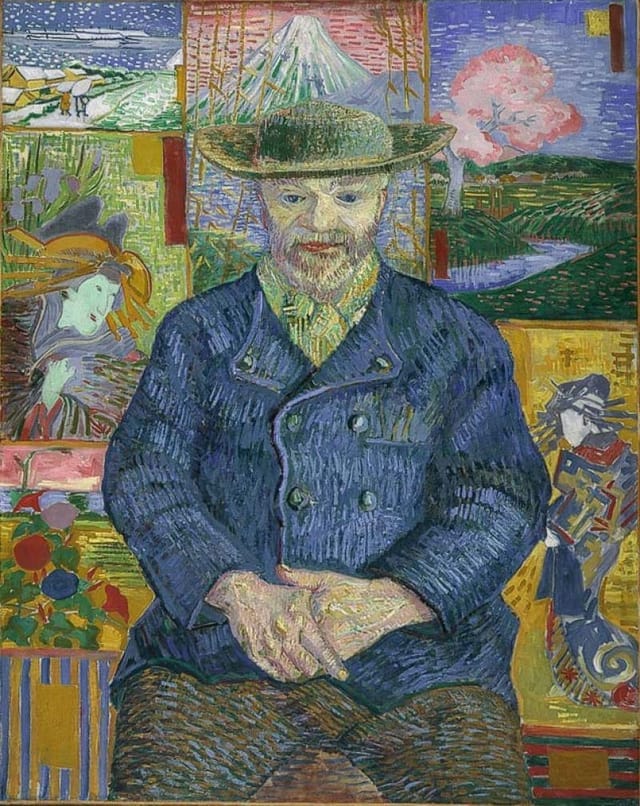
The painting you are looking at now is Portrait of Père Tanguy by Vincent van Gogh.
If you look at the painting, you can see a man sitting in the center.
This man is Julien Tanguy, one of the important figures in the Paris art scene of the 1890s.
Tanguy ran a paint shop near Place Pigalle in Paris.
Since paint was essential for artists to create their works, he naturally became friends with many painters.
Among the artists who spent time with him were well-known figures such as Claude Monet, Pierre-Auguste Renoir, Camille Pissarro, Paul Cézanne, and Vincent van Gogh.
Tanguy supported these artists in his own way.
Because he owned a paint shop, he sometimes provided them with painting supplies for free. He also displayed their works in his shop so that more people could see them.
One day, when Van Gogh visited his shop, he painted Tanguy’s portrait as a way of expressing his gratitude.
It is believed that Van Gogh painted a total of three portraits of Père Tanguy.
This is one of those three portraits.
Now, let’s take a closer look at the painting.
As you can see, the man sitting in the center is Tanguy.
Behind him, you can see many posters featuring Japanese imagery.
At the time, Japanese culture was incredibly popular in Europe.
Many artists collected Japanese paintings and prints and found inspiration in them.
Van Gogh was no exception.
So when Van Gogh painted Tanguy, he portrayed him almost like an Eastern sage, giving him a calm and wise presence.
In the background, he included various symbols of Japan, from Mount Fuji to geisha figures.
Looking at the technical aspects of the painting, Van Gogh skillfully used complementary colors, which are colors that contrast strongly with each other.
You can also clearly see his signature impasto technique, where thick layers of paint are applied with visible brushstrokes.
This technique gives the figure a stronger sense of depth and presence. Personally, I consider this painting one of Van Gogh’s hidden masterpieces.
Rodin also admired this style of Van Gogh’s work, and after Tanguy passed away, he purchased this painting.
Take your time appreciating the painting, and when you’re ready, we’ll move on to the next work.