In a Café (The Absinthe Drinker)
Transcript
Here's what your guide tells you about this work in the MuseCat app.
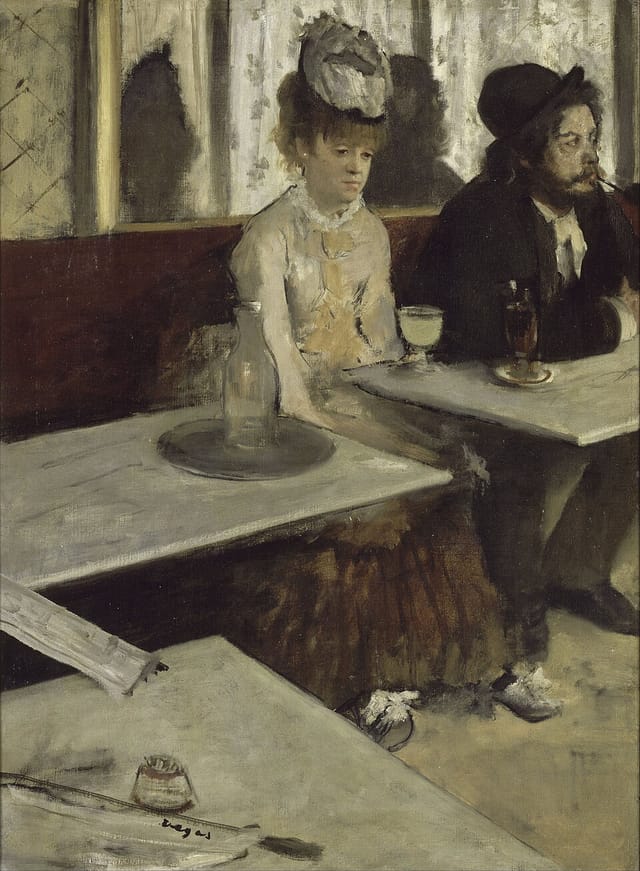
The painting you're looking at now is In a Café by Edgar Degas. As you can see, the scene is set inside a café in Paris. A woman and a man are seated together. They may look like a couple, but something seems off. There's a certain tension between them. The woman doesn't look particularly happy either.
If you look at the composition, you'll notice that the scene is shown from an angle, as if the artist were sitting elsewhere in the café, observing the couple at a table across the room. Capturing an ordinary moment as though it were a snapshot taken with a camera is one of the defining characteristics of Impressionism.
Although many Impressionist paintings were created outdoors, many of Degas's works, including this one, are set indoors. That's because Degas had poor eyesight and preferred painting indoors rather than outside. As a result, most of the Degas paintings were painted indoors.
Now, let's look back at the painting. On the table in front of the woman, you'll see a glass. It's filled with a drink called absinthe.
At the time, absinthe was inexpensive but extremely strong, with an alcohol content of around 70 percent. Because it was a cheap way to get drunk quickly, it was especially popular among the working class. In fact, it became so popular in Paris that people even referred to the hours between five and seven in the evening as the "Green Hour," named after the drink's distinctive color. From this, we can infer that the two people in the painting belong to the working class.
Now, take a closer look at the drink. It isn't bright green. Instead, it has a cloudy, milky appearance. That's a remarkably realistic detail. Although absinthe is naturally green, it was traditionally served by placing a slotted spoon over the glass, setting a sugar cube on top, and slowly dripping cold water over the sugar. As the sugar dissolved and mixed with the absinthe, the drink turned cloudy, just as you see in this painting. Degas captured that detail with remarkable accuracy.
Seventeen years after it was painted, this work was exhibited in London. The British public was shocked. The title was In a Café, but it looked nothing like the elegant Parisian café culture they had imagined. To them, Parisian cafés were refined places where intellectuals gathered to discuss ideas and enjoy each other's company. But the café Degas painted was something entirely different. It portrayed the everyday lives of ordinary people living in Paris.
Take your time enjoying the painting.