Water Lilies — first oval room
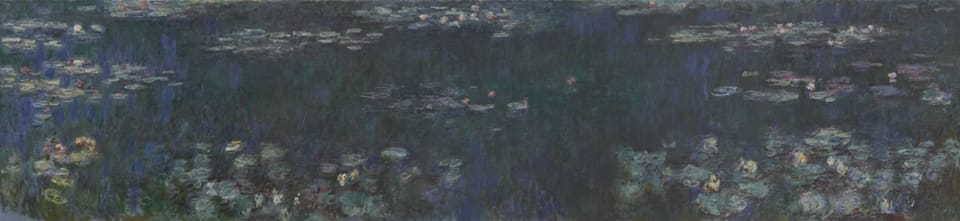
Now, we've entered the first room of Monet's Water Lilies.
If there's an empty seat on one of the benches in the center, please have a seat and make yourself comfortable as you listen.
As I mentioned earlier, Monet wanted this to be more than just a place to look at paintings. He wanted it to feel like a spiritual and sacred space.
So while you're here, please try to enjoy the paintings as quietly as possible.
You can also take off your headphones for a moment and spend some time meditating if you'd like.
When you're ready, put your headphones back on and continue listening.
First, let me tell you a little about this space.
The first room we're in now and the second room are both oval-shaped and connected to each other.
Together, they resemble the infinity symbol you probably learned about in math class at school.
You know, the one that looks like the number 8 turned on its side.
Monet designed the rooms this way because he wanted the space to express a sense of eternity, transcending time and space.
The paintings are also arranged to reflect the passage of time.
The first room features Water Lilies scenes associated with sunset, while the second room features scenes associated with sunrise.
So evening and morning continue in an endless cycle.
The rooms were also designed to receive natural light through the ceiling, without separate artificial lighting.
This light changes throughout the day, and it also changes with the weather.
The space was carefully designed so that Monet's paintings would look different as the light changed.
Monet worked closely with the architect Camille Lefèvre to plan all of these details.
You can think of this space as Monet's attempt to create an immersive experience that goes beyond simply looking at paintings—one where you become part of the artwork through the changing flow of light and time.
Now, let's take a closer look at the paintings.
Monet's Water Lilies were inspired by the pond at his home in Giverny.
Monet wanted to capture the beauty of light as it changed from moment to moment.
But a single painting could never capture all those constant changes, so he painted the same subject over and over again.
He is known to have painted around 250 works featuring water lilies alone.
And among them, the eight works here at the Musée de l'Orangerie can be considered the masterpieces of his Water Lilies series.
Rather than looking at each painting individually, let's first talk about what they have in common. Monet was suffering from cataracts at the time, which gives these paintings a somewhat dreamlike quality. His cataracts caused his vision to become blurred.
And as you can see, every painting in these rooms is enormous.
The longest one measures an incredible 12.75 meters, with each painting covering almost an entire wall.
And because the paintings aren't enclosed in frames, they don't feel separated from one another. Instead, they seem to flow continuously around the rooms.
Monet also experimented with a variety of techniques while creating the eight paintings displayed here.
If you step a little closer, you'll notice that he used long, straight brushstrokes for the trunks and branches of the willow trees, while the water lilies floating on the pond were painted with thick layers of paint.
He also layered his brushstrokes, so when you look at the paintings up close, the forms appear blurred and indistinct.
It's only when you step back from the paintings that the images begin to come into clearer focus.
Now, take your time and enjoy the paintings. When you're ready, let's move on to the next room.