Portrait of Madame Cézanne
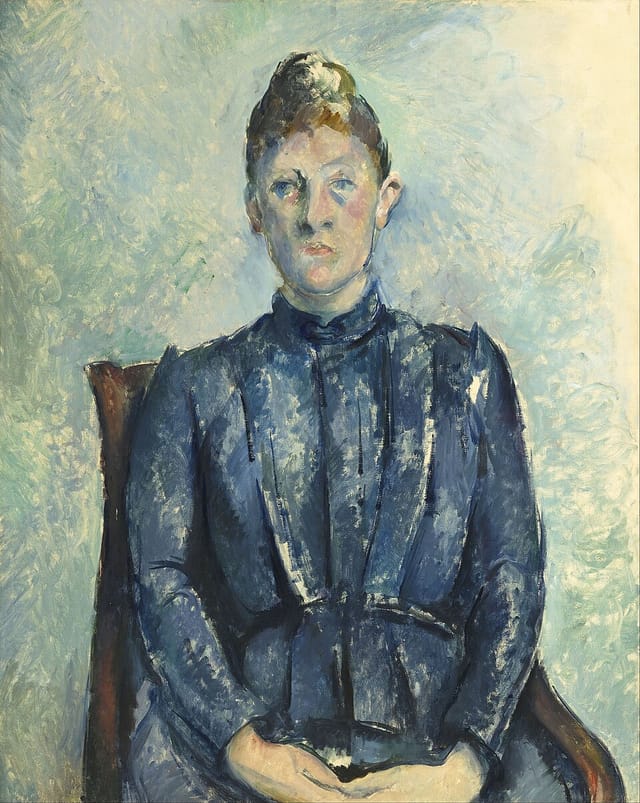
The painting you're looking at is a portrait of Cézanne's wife, Hortense Fiquet.
Hortense met Cézanne when she was 19 and went on to model for many of his paintings over the next 30 years.
This is one of those portraits.
Now, let's take a closer look.
Look at Hortense's face. She is sitting there with a completely neutral expression, isn't she?
She wasn't angry or upset—this was apparently simply her usual expression.
She was also said to be able to sit still for hours without ever complaining.
It may sound a little funny, but Cézanne appreciated both her expressionless face and her patience because they allowed him to concentrate entirely on his painting without distraction.
At first glance, this painting may look rather casually composed, but it actually has a remarkable sense of symmetry.
Imagine dividing the painting in half along a line running through Hortense's nose, and you'll see that the composition is almost perfectly symmetrical.
But to keep that symmetry from feeling too rigid, Cézanne cleverly placed the chair at a slight angle.
Now, look at the lighter areas of her clothing.
In some of these areas, Cézanne didn't apply paint at all, deliberately leaving the canvas exposed.
Since the canvas itself was already white, he simply left those areas unpainted.
This was a rather unusual approach.
And if you look closely, you can clearly see the individual brushstrokes, giving the painting a quickly painted, spontaneous quality.
So at first glance, parts of the painting may seem unfinished, but those visible brushstrokes actually give the work a greater sense of energy and life.
Now, take your time and enjoy the painting.
When you're ready, let's move on to the next work.