Père Junier's Cart
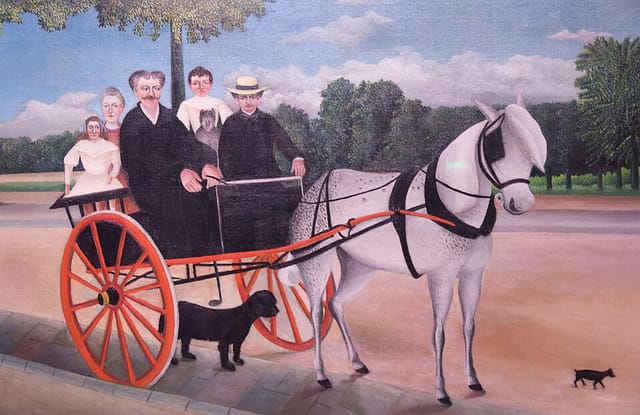
The painting you're looking at is Henri Rousseau's The Cart of Père Junier
Père Junier owned a grocery store that Rousseau often visited.
Junier and Rousseau were quite close. Junier would let him buy food on credit, and they would sometimes eat together.
Rousseau felt bad about always receiving his help, so he decided to make a painting for the Junier family based on a photograph of them setting off on a carriage ride to the countryside.
Because Rousseau painted it in his own distinctive style, it doesn't look exactly like the photograph, but you can still see that he followed it pretty closely, right?
The main difference is that he added Junier's niece and grandniece, who weren't in the original photograph.
What's especially interesting is the unusual composition and the way the figures are depicted.
If you look at the painting, everyone except Père Junier, whose body is slightly turned, faces straight forward, almost like figures in ancient Egyptian art.
And look at the sizes of the people. Much like in medieval art, where important figures were painted larger and less important figures smaller, Rousseau freely varied their sizes.
The proportions and positions of the dogs are also quite unusual.
For example, the dog with Junier's niece has a head that almost looks like a goblin.
At the time, his niece apparently liked to put little clips on the dog's ears, and Rousseau gave that detail a playful twist.
The dog under the carriage looks unrealistically large, while the little dog in front of the horse looks unrealistically small.
And if you look at the horse, it almost seems to be standing on tiptoe.
This makes the horse look as though it's floating above the ground.
It's almost as if everything in this painting is saying, “I'm not real.” That's a good way to understand Rousseau's distinctive style.
Now, take your time and enjoy the painting. When you're ready, let's move on to the next work.