Paris · Palace & Rooms
The Room of 1830
Palace of Versailles · Paris, France
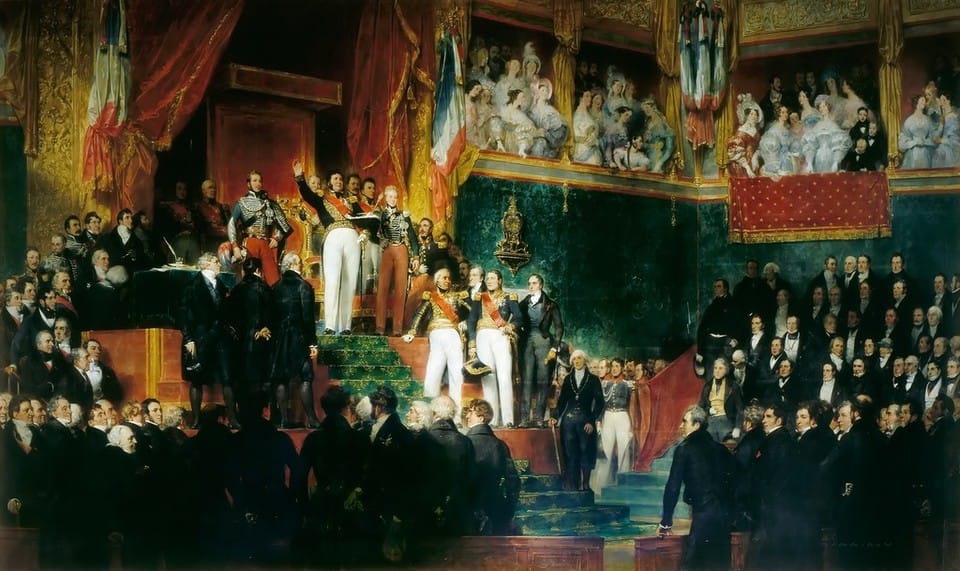
This room takes its name from the July Revolution of 1830 and the constitutional oath Louis Philippe swore that year. Making sense of 1830 means tracing roughly forty years of French history after the 1789 Revolution.
The 1789 Revolution brought down the monarchy and left France, for the first time, without an absolute ruler — a vacuum that triggered fierce struggles over who should govern, sending thousands to the guillotine. Amid this chaos, Napoleon rose to fame through heroic exploits abroad. To a people exhausted by internal strife, his strength looked like the surest path back to order, and he was eventually crowned the absolute ruler the citizens themselves wanted: emperor. Ten years after taking the throne, however, Napoleon was defeated at Waterloo and exiled to a remote island. Seeing an opportunity, the other monarchies of Europe pressed for a king to be restored in France, and Louis XVIII took the throne. Politically astute, he respected the spirit of the Revolution and governed through compromise with the citizenry. When he died without an heir, his brother Charles X succeeded him. Unlike his conciliatory brother, Charles X moved immediately to reassert absolute royal power upon taking the crown. But the world had already changed, and his heavy-handed rule provoked the July Revolution of 1830. With Charles X driven out, France again faced the question of whether to become a republic or restore the monarchy — and into that moment stepped Louis Philippe. A royal who had fought alongside ordinary citizens, he declared that he would be a king who upheld the laws made by the people rather than one who claimed hereditary absolute power. In 1830, Louis Philippe took his constitutional oath on that basis.
Louis Philippe, too, eventually became a target of revolution. Though he appeared at first to champion the common people, he increasingly came to represent the interests of the nobility and the bourgeoisie, and public resentment over corruption and excess steadily built. In the 1840s, poor harvests combined with an industrial depression to trigger an economic crisis, which ultimately led to the February Revolution of 1848.